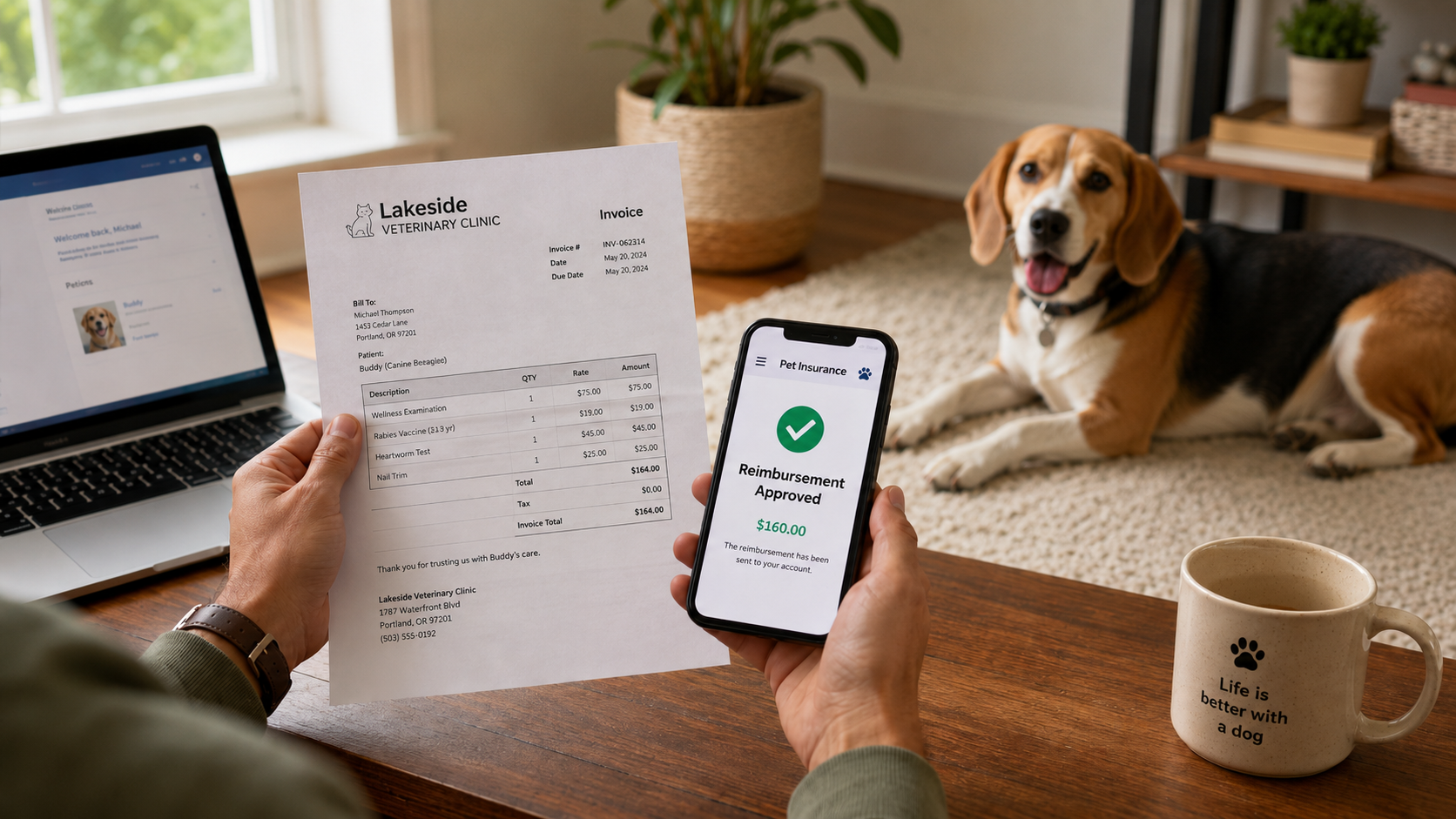
Pet insurance reimbursement is the process insurers use to pay pet owners back for eligible veterinary expenses. Unlike many human health insurance plans, pet insurance usually requires you to pay the veterinarian first, submit a claim, and then receive reimbursement based on the terms of your policy.
The American Animal Hospital Association (AAHA) describes this reimbursement model as the typical way pet insurance works, although some insurers may offer direct payment to veterinary clinics.
Understanding that process matters because the amount you receive can be very different from the total on your veterinary bill. Your deductible, reimbursement percentage, annual coverage limit, exclusions, and even the insurer’s calculation method can affect your final payment.
Before choosing a policy—or submitting your next claim—it helps to understand exactly how pet insurance reimbursement works and which numbers deserve the most attention.
How Does Pet Insurance Reimbursement Work?
In most cases, the reimbursement process begins after your pet receives treatment. You visit the veterinarian, authorize the recommended care, and pay the clinic directly.
You then submit a claim to your pet insurance company. Insurers commonly ask for an itemized invoice, proof of payment, and sometimes medical records or treatment notes. Claims can typically be submitted through an insurer’s website, mobile app, email, or another approved method.
The insurer reviews the claim to determine which expenses are eligible under your policy. Your deductible and reimbursement rate are then applied according to the plan’s rules, subject to coverage limits.
If the claim is approved, reimbursement is generally sent by direct deposit or check. AAHA notes that keeping invoices, receipts, and medical records can make the process easier when filing claims.
What Is a Pet Insurance Reimbursement Rate?
Your reimbursement rate is the percentage of eligible veterinary expenses your insurance company agrees to pay after applicable policy terms are taken into account.
For example, a plan with an 80% reimbursement rate generally means the insurer covers 80% of qualifying costs while you remain responsible for the other 20%, after the applicable deductible calculation.
Many plans allow owners to choose their reimbursement percentage when enrolling. AAHA reports that pet insurance policies may reimburse between 60% and 100% of eligible expenses, although available options differ by provider and policy.
A higher reimbursement percentage can reduce your share of a large covered veterinary bill. However, plans offering more generous reimbursement generally cost more. This creates a tradeoff between what you pay in premiums and how much financial responsibility you retain when your pet needs treatment.
How Deductibles Affect Your Reimbursement
A deductible is the amount you must satisfy before your insurance coverage begins paying according to the policy.
Some pet insurance plans use an annual deductible that resets each policy year. Others may structure deductibles differently, so reviewing the actual policy wording is important.
Consider an eligible $2,000 veterinary bill with a $250 remaining deductible and an 80% reimbursement rate. If the insurer subtracts the deductible first, $1,750 remains eligible for the percentage calculation. At 80%, the resulting reimbursement would be $1,400, assuming there are no excluded charges or coverage-limit issues.
That example is useful for understanding the math, but insurers do not necessarily calculate claims in exactly the same order. Spot notes that pet insurers may use several reimbursement approaches, including subtracting the deductible before applying the reimbursement percentage or applying the percentage before subtracting the deductible.
Always check your own policy rather than assuming a universal formula.
Why the Reimbursement Calculation Method Matters
Two policies can advertise the same deductible and reimbursement percentage yet produce different payments if they use different calculation methods.
One insurer might identify covered charges, subtract your remaining deductible, and then apply your reimbursement rate. Another could apply reimbursement first and subtract the deductible afterward. Some policies may instead rely on a benefit schedule that establishes maximum payments for particular services or conditions.
A benefit schedule can be especially important to understand. Instead of simply paying a percentage of whatever your veterinarian charges, the insurer may set a predetermined maximum benefit for a covered treatment. If your veterinarian charges more than that amount, you may be responsible for the difference.
When comparing policies, don’t look only at a phrase such as “90% reimbursement.” Find out exactly what the percentage applies to and how the insurer calculates an eligible claim.
Annual Limits Can Change What You Actually Receive
Your reimbursement rate does not necessarily represent the maximum amount your insurer will pay during the year.
Many policies also include an annual reimbursement or coverage limit. This is the maximum the insurer will pay for eligible claims during a policy period. Some plans offer several limit options, while others may provide unlimited annual coverage.
Suppose your policy has already reimbursed you close to its annual maximum when your pet requires another expensive procedure. Even if that procedure is covered and your deductible has been satisfied, your remaining annual benefit can limit the amount you receive.
According to AAHA, pet insurance limits may be structured annually or by condition, depending on the plan, and some policies offer unlimited payouts.
This is why comparing pet insurance reimbursement should include the deductible, reimbursement rate, and payout limit rather than any one feature in isolation.
What Veterinary Expenses Are Eligible for Reimbursement?
Coverage depends heavily on the type of policy you purchase. Accident-and-illness plans generally provide broader protection than accident-only plans, while wellness or preventive-care benefits may be offered separately.
Depending on the policy, eligible expenses may include diagnostic testing, surgery, hospitalization, prescription medications, and treatment for qualifying illnesses or accidental injuries. Some plans may also cover hereditary conditions, behavioral treatment, rehabilitation, dental illness, or alternative therapies.
AAHA identifies diagnostics, surgeries, medications, hospitalization, and certain hereditary or congenital conditions among expenses that pet insurance may cover.
The key word is “may.” Coverage varies significantly between insurers.
An expensive procedure is not automatically reimbursable simply because a veterinarian believes it is medically necessary. The treatment also needs to satisfy the definitions, conditions, limits, and exclusions stated in your insurance contract.
Why Pet Insurance Claims Get Denied or Reduced
A reimbursement can be lower than expected because part of the veterinary bill does not qualify for coverage.
Pre-existing conditions are one major consideration. Pet insurance is primarily designed to help with future eligible veterinary expenses rather than problems that already existed before coverage took effect. Waiting periods can also prevent reimbursement when an illness or injury occurs too soon after enrollment.
Other possible reasons for a reduced or denied claim include services excluded by the policy, reaching a coverage limit, missing documentation, or expenses that fall outside the plan’s definition of covered care.
Reviewing your explanation of benefits or claim decision can help you understand how the insurer reached its conclusion. If something appears incorrect, check the insurer’s appeal or claim-review process and provide any supporting medical records requested.
How Long Does Pet Insurance Reimbursement Take?
Pet insurance reimbursement time varies by company and claim complexity.
Straightforward claims with complete documentation may move relatively quickly, while claims requiring additional veterinary records or a review of your pet’s medical history may take longer. MoneyGeek reports that many pet insurers process reimbursements within roughly 7 to 14 days after receiving a complete claim, but actual timelines vary by insurer.
The best approach is to check your provider’s current claims guidance rather than relying on an industry-wide estimate.
Submitting a complete itemized invoice and any requested records can help prevent avoidable delays. Direct deposit may also get an approved reimbursement into your account faster than waiting for a mailed check, depending on your insurer’s options.
Remember that processing speed and coverage are separate issues. A fast claim is useful, but accurate and comprehensive coverage is more important when choosing a policy.
How to File a Pet Insurance Claim Smoothly
A little organization can make the pet insurance claim reimbursement process much less frustrating. Before leaving the veterinary clinic, make sure you have documentation showing what services were performed and what you paid.
A practical claim routine is:
- Ask for a detailed, itemized veterinary invoice rather than only a credit-card receipt.
- Keep your pet’s medical records organized, particularly when changing veterinary clinics.
- Review the insurer’s claim deadline and submit eligible expenses promptly.
- Upload every requested document at the same time when possible.
- Check that your name, pet information, treatment dates, and invoice details are accurate.
- Save the claim confirmation and monitor its status through your insurer’s portal or app.
- Review the final reimbursement statement so you understand deductions, excluded charges, and remaining annual benefits.
Insurers may request additional information directly from your veterinarian. Responding promptly when documentation is needed can help prevent your claim from sitting incomplete.
Should You Choose 70%, 80%, or 90% Reimbursement?
There is no single pet insurance reimbursement percentage that works best for every household.
A lower reimbursement option may reduce your premium while leaving you responsible for a larger share of covered treatment costs. A higher reimbursement percentage may provide stronger protection against major veterinary bills but usually comes with a higher premium.
Think about the amount you could realistically pay after an unexpected emergency. Someone who is comfortable absorbing a larger share of veterinary expenses might prioritize a lower premium. Someone who wants to minimize unpredictable out-of-pocket costs may prefer a higher reimbursement percentage.
Your deductible and annual limit should be evaluated at the same time. A 90% plan with a restrictive limit can provide less financial protection during an exceptionally expensive year than the percentage alone suggests.
Compare the complete policy design—not just the biggest number featured on the quote page.
Does Pet Insurance Pay the Vet Directly?
Usually, pet insurance works by reimbursing the owner rather than functioning like traditional human health insurance billing.
That means you may need enough cash or available credit to pay the veterinary clinic before receiving insurance money. This is an important budgeting consideration, particularly when dealing with emergency surgery or hospitalization.
However, direct-vet-payment options do exist with some pet insurance companies and veterinary practices. AAHA notes that owners generally pay the veterinarian first unless their insurance company offers a direct-payment option.
If upfront veterinary costs are a major concern, ask prospective insurers how their direct-pay system works. Find out whether your veterinarian must participate, whether approval is required before treatment, and which portion of the bill you still need to pay at checkout.
Direct payment can be convenient, but eligibility and procedures vary, so verify the details before relying on it during an emergency.
How to Compare Pet Insurance Reimbursement Before Buying
The monthly premium is only one part of a pet insurance comparison. Understanding what happens when you actually file a claim is just as important.
Start by comparing each plan’s reimbursement percentage and deductible. Then look at annual or condition-specific limits, calculation methods, waiting periods, pre-existing-condition rules, and major exclusions.
It is also worth checking whether examination fees, prescriptions, dental illnesses, rehabilitation, hereditary conditions, or other services important to you are included. Coverage that looks similar on the surface can differ considerably once definitions and exclusions are examined.
Ask each insurer to show you a sample claim calculation. Using the same hypothetical veterinary bill across several providers can make differences much easier to see.
Finally, read a sample policy before enrolling whenever one is available. Marketing pages summarize benefits; the policy itself determines how reimbursement actually works.
Understanding Reimbursement Helps You Avoid Expensive Surprises
Pet insurance reimbursement becomes much easier to understand once you focus on four questions: What expenses are covered? What deductible applies? What percentage does the insurer reimburse? What limits or exclusions can reduce the payment?
Pet insurance will not necessarily eliminate veterinary expenses. You may still pay deductibles, coinsurance, excluded charges, premiums, and costs exceeding your policy limits. You may also need to pay a veterinarian upfront before your claim is processed.
But understanding those responsibilities before buying a plan makes it easier to compare policies based on real financial protection rather than price alone.
When reviewing pet insurance, calculate a few hypothetical claims yourself. That simple exercise can reveal how much you might actually receive when a costly accident or illness occurs—and whether the policy fits both your pet’s needs and your budget.
Leave a Reply