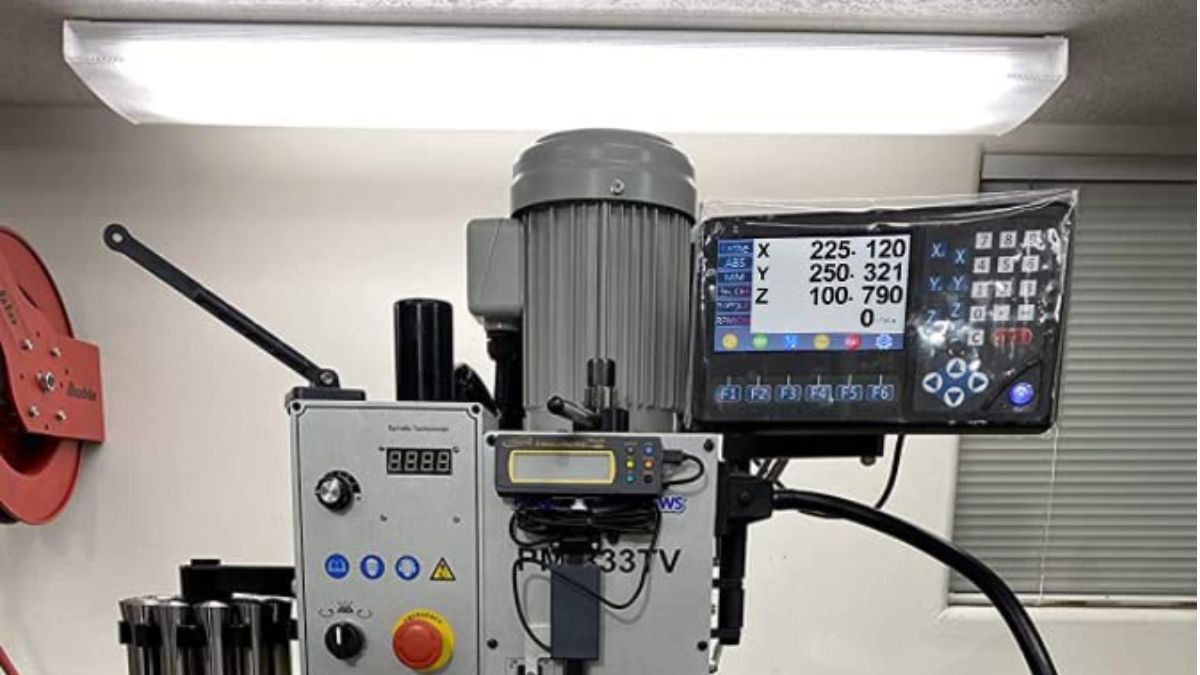
The precision demands of modern machine shops are no longer satisfied by manual measurement or aging readout systems. For those looking to increase accuracy, speed, and reliability on milling or turning machines, a digital readout (DRO) is no longer optional—it’s fundamental.
The DITRON 3-Axis DRO system with magnetic scales enters this space with an uncommon mix of industrial durability, fine measurement resolution, and thoughtful usability features.
But does it truly stand out in a crowded market of DRO kits? Here’s why it deserves a serious look.
Designed to Withstand the Realities of the Shop Floor
Machining environments are rough. Coolant mist, metallic chips, vibration, and thermal expansion are everyday conditions—not exceptions. The DITRON system appears designed with these realities in mind.
- IP67 rating means the entire DRO system is protected from coolant sprays and dust infiltration, which are leading causes of DRO failure.
- Magnetic scale technology avoids the fragility of traditional glass scales. Since there are no contact surfaces, wear and mechanical drift are virtually eliminated.
- Steel housing and cable shielding provide added resilience, especially for shops running multiple shifts or handling heavier workpieces.
Unlike optical systems that often require purge systems or careful sealing, the DITRON magnetic setup performs in messy conditions with less maintenance—and fewer shutdowns.
Precision Backed by Calibration, Not Just Claims
A 5μm resolution isn’t unusual on paper. What’s notable is that every unit is reportedly laser-calibrated to verify that level of precision across its working envelope.
More importantly, real-world usage confirms:
- Stable readings even at rapid traverse speeds.
- Minimal signal noise despite nearby industrial electronics.
- Repeatability across different setups and temperatures.
This level of predictability is what makes the difference between tight tolerances being met—or missed.
Not Just a Display: A Productivity Tool
The 7-inch true color LCD is more than eye candy. It supports:
- Real-time graphical path visualization, making it easier to see tool movement patterns.
- 200-tool memory, reducing the constant recalibration or manual data entry.
- Bolt-hole and bevel functions, cutting down setup and math time during repetitive tasks.
It also offers features that shop-floor techs appreciate but often overlook—like axis summing, instant inch/metric switching, and linear/nonlinear error compensation.
All of which reduce reliance on outside calculators, notes, and guesswork.
Installation That Doesn’t Require a Retrofit Engineer
Installing a DRO system can often feel like a custom fabrication job. The DITRON kit eases that friction with:
- Comprehensive mounting hardware that fits most lathes, mills, and grinders.
- Flexible readhead positioning and clear signal indicators for proper alignment.
- Software that guides through machine-specific settings like axis limits and backlash compensation.
Most users should be able to complete setup without additional tools or advanced electrical knowledge. For small- to mid-size shops, that means less downtime and no need to hire outside help.
Reliable Performance That Justifies the Cost
At $554, the DITRON 3-Axis DRO falls into a midrange price bracket—but includes magnetic scales typically found in higher-end systems.
- Lower lifetime cost: Unlike optical scales that may need replacing after a few years, magnetic versions usually last longer—especially under coolant-heavy conditions.
- Higher uptime: With fewer components prone to failure or misalignment, shops experience fewer unexpected stoppages.
- Faster payback: Improved accuracy and reduced scrap translate into quicker ROI, particularly in production or tooling environments.
Available on Amazon, it’s accessible without special distributors or long lead times, and it ships with full warranty coverage and customer support.
Bottom Line: Built for Machinists, Not Just for Specs
The DITRON 3-Axis DRO system doesn’t introduce radically new technology—but it does apply proven components in a more durable, smarter package.
It reduces the usual weaknesses associated with DROs (fragility, contamination, tedious setups) and replaces them with tangible improvements where it counts most: accuracy, usability, and uptime.
For machinists who’ve grown tired of drifting scales, cryptic interfaces, or brittle glass units, this model offers a practical upgrade. Its performance isn’t about flash—it’s about reliability, shift after shift.
Leave a Reply