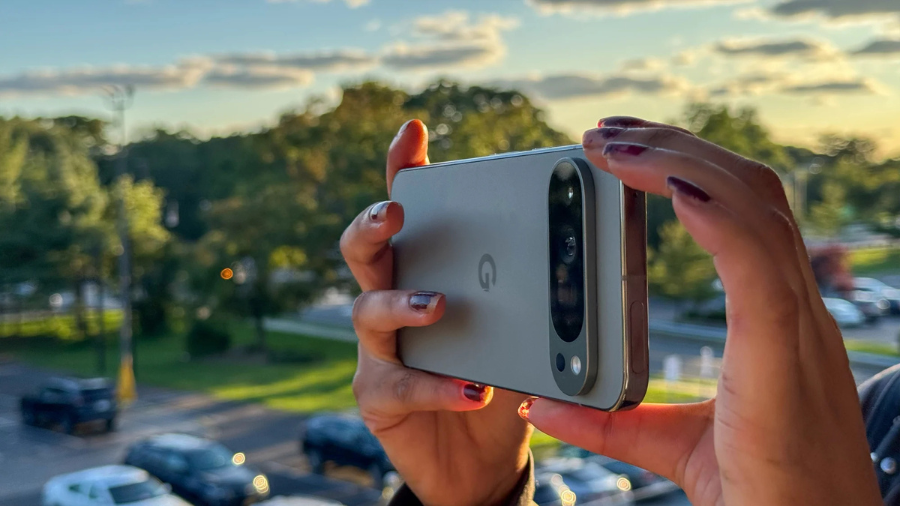
The smartphone landscape shifts dramatically each year, but Google’s Pixel 9 Pro stands as a testament to thoughtful innovation rather than flashy gimmicks. Released in September 2024, this device represents Google’s most refined hardware offering to date. I’ve spent weeks with this compact powerhouse, and what strikes me most isn’t just its impressive spec sheet, but how seamlessly it integrates into daily life.
Design and Build Quality
The Google Pixel 9 Pro represents a thoughtful evolution in Google’s hardware design philosophy. Measuring 152.8 x 72 x 8.5 mm, this device strikes an impressive balance between screen real estate and one-handed usability. In a market dominated by increasingly larger devices, the Pixel 9 Pro’s dimensions make it notably more compact than many competing flagships while maintaining premium functionality.
The craftsmanship is immediately apparent through the marriage of a matte glass back with a polished metal frame. This combination not only creates a visually striking aesthetic but also serves practical purposes—the matte finish resists fingerprints while providing adequate grip. At 199 grams, the weight distribution feels considered, neither too heavy to cause fatigue during extended use nor too light to feel insubstantial.
Color Palette and Material Choices
Google offers the Pixel 9 Pro in four distinct colorways:
- Obsidian: A sophisticated black that maintains professional appeal
- Porcelain: A clean, neutral tone that complements most accessories
- Hazel: A muted green that stands out without being ostentatious
- Rose Quartz: A subtle pink option that adds personality
Each color variant maintains the same premium material quality, though the Obsidian tends to show fingerprints more readily than the lighter options.
Durability Considerations
The IP68 rating provides serious protection against environmental hazards. This certification ensures the device can withstand submersion in up to 1.5 meters of freshwater for 30 minutes. Beyond the technical specifications, this translates to practical reassurance during rainy days, accidental spills, or brief dunks.
The Corning Gorilla Glass Victus 2 provides an additional layer of protection against drops and scratches, though prudent users will still want to consider a case for maximum protection of this premium device.
Display Excellence: The Super Actua OLED
The 6.3-inch Super Actua LTPO OLED display establishes the Pixel 9 Pro as a visual powerhouse. With a resolution of 1280 x 2856 pixels and approximately 495 PPI density, text appears razor-sharp, images show remarkable detail, and interface elements maintain crisp definition regardless of viewing distance.
Perhaps most impressive is the display’s peak brightness capability of 3,000 nits. This exceptional brightness enables comfortable viewing even in direct sunlight—a scenario where many smartphones struggle. The practical benefit becomes evident when using navigation apps outdoors or trying to capture photos while framing shots in bright conditions.
Adaptive Refresh Rate Technology
The LTPO (Low-Temperature Polycrystalline Oxide) technology enables variable refresh rates ranging from 1Hz to 120Hz. This adaptive system intelligently adjusts based on screen content—dropping to lower rates when displaying static content like text or photos, then ramping up to the full 120Hz for scrolling or gaming.
The strategic implementation of this technology delivers two key benefits:
- Smoother visual performance during high-motion activities
- Reduced power consumption when high refresh rates aren’t necessary
This balance contributes significantly to the device’s battery efficiency without compromising on visual fluidity.
Performance and Hardware
The Google Tensor G4 processor represents Google’s continued commitment to purpose-built silicon. While the chip may not lead synthetic benchmarks compared to competitors like the Snapdragon 8 Gen 3, its real-world performance tells a different story. Google’s focused optimization creates responsive performance across typical usage scenarios.
The inclusion of 16GB LPDDR5X RAM provides substantial headroom for multitasking. This generous allocation allows users to keep numerous apps in memory simultaneously, reducing reload times and creating a more seamless experience when switching between applications.
Thermal Considerations
The Tensor G4’s thermal management reveals some limitations during sustained intensive workloads. Extended gaming sessions or consecutive 4K video recording can cause noticeable device warming. While never reaching temperatures, this heat generation can result in performance throttling to protect components. This thermal behavior represents one of the few areas where the Pixel 9 Pro falls slightly behind competitors with more aggressive cooling solutions.
Camera System: Computational Photography Mastery
The Pixel 9 Pro’s triple rear camera system elevates Google’s computational photography approach to new heights. The primary 50MP wide camera (f/1.68) captures remarkable detail in various lighting conditions. Color reproduction maintains Google’s signature natural aesthetic while preserving accurate skin tones across different complexions.
The 48MP ultrawide camera (f/1.7) provides an impressive field of view without the extreme distortion often found in competing ultrawide lenses. The inclusion of Macro Focus capabilities transforms this lens into a versatile tool for close-up photography of small subjects.
Telephoto Performance
The 48MP telephoto camera (f/2.8) with 5x optical zoom represents significant improvement over previous generations. The optical reach allows for clean, detailed shots of distant subjects without the quality degradation associated with digital zoom. For situations requiring even greater magnification, Google’s Super Res Zoom technology extends the effective range while maintaining surprising clarity.
Video Capabilities
Video recording capabilities now include 8K at 30fps, though most users will find the 4K options provide the optimal balance between quality and file size. Video stabilization remains exceptional, producing smooth footage even during movement. The combination of optical and electronic stabilization creates results that often appear to have been captured with dedicated equipment.
The 42MP front camera delivers outstanding selfie quality with natural skin tones and impressive dynamic range. Video calls benefit from the high-resolution sensor, providing clarity that exceeds typical conferencing needs.
The Verdict: Is the Pixel 9 Pro Worth It?
After extensive testing, the Google Pixel 9 Pro emerges as one of the most compelling flagship smartphones of 2025. Its combination of exceptional camera quality, premium build, and industry-leading software support creates a package that’s difficult to overlook. While the Tensor G4 may not win raw benchmark competitions against some rivals, the real-world performance and AI capabilities more than compensate. The compact form factor will particularly appeal to those tired of unwieldy devices, proving that premium experiences don’t require oversized hardware. At its price point, the Pixel 9 Pro delivers tremendous value, especially considering the 7-year software commitment—essentially future-proofing your investment through 2031. For photography enthusiasts, Android purists, or anyone seeking a balanced flagship experience, the Pixel 9 Pro stands as Google’s most refined offering yet. The question isn’t whether this device is good—it’s whether any competitor can match its unique combination of hardware excellence and software intelligence.
Leave a Reply